Grave injustices in Qatar and Iran
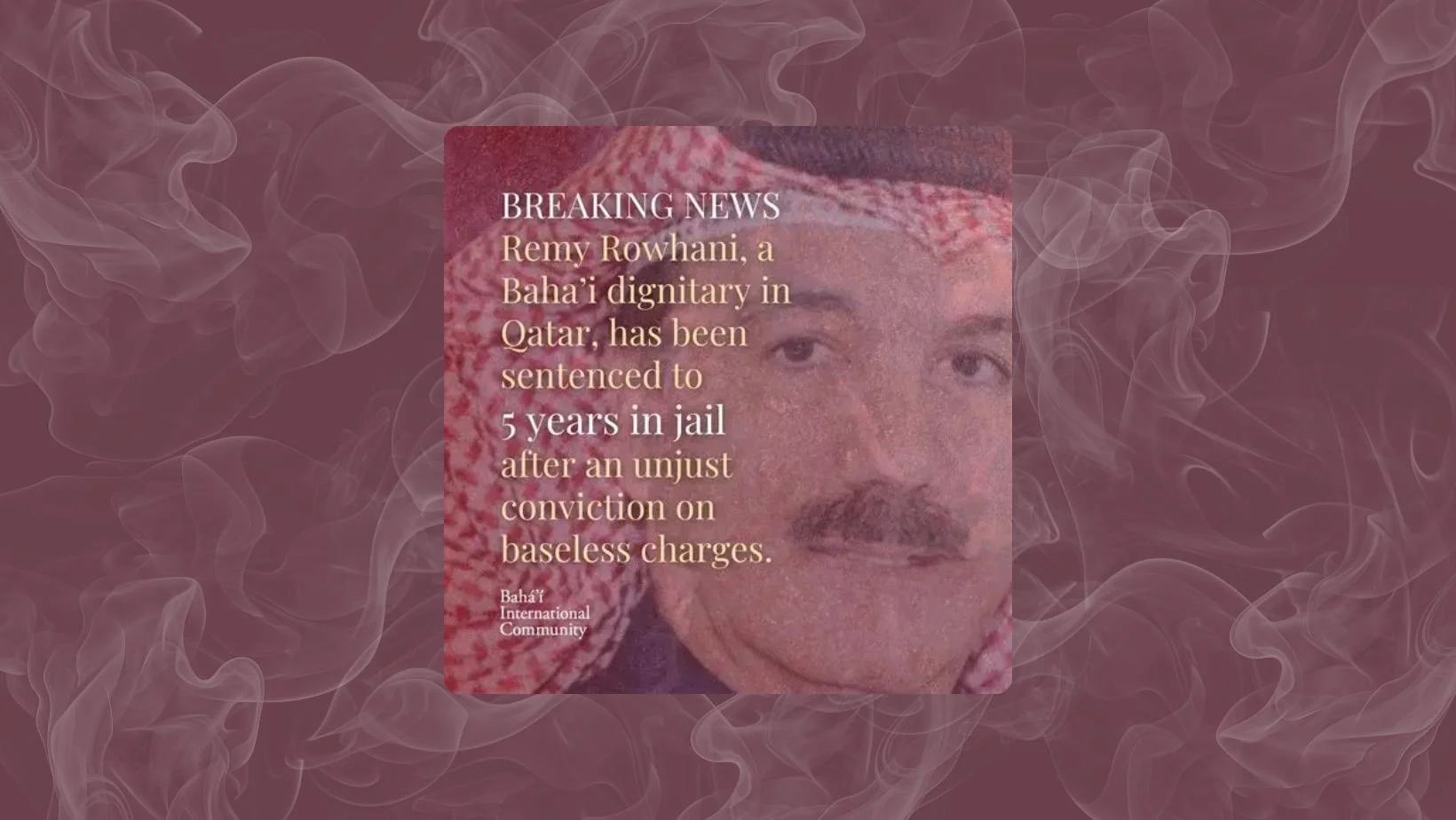
A respected member of the Bahá’í community in Qatar, Mr. Remy Rowhani, has been sentenced to five years in prison by a court in Doha on unfounded charges. Mr. Rowhani, a distinguished Qatari citizen and beloved Chairperson of the National Spiritual Assembly of the Bahá’ís of Qatar for the past eight years, was convicted on 13 August 2025 under laws used to silence religious minorities.
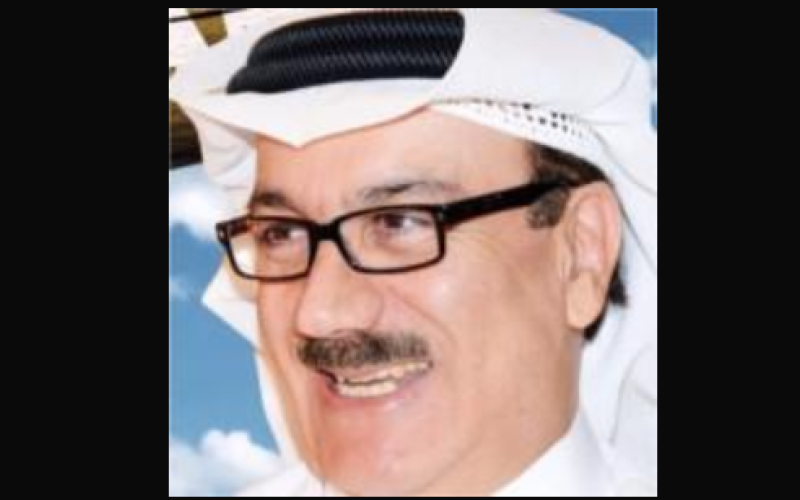
Mr. Remy Rowhani, Chairperson of the National Spiritual Assembly of the Bahá’ís of Qatar.
Source: The Bahá’í International Community
The charges, which included “promoting a doctrine that casts doubt on Islam” and “violating social values using information technology,” were based largely on posts from the Qatari Bahá’í community’s official X account. These posts contained quotations from the Bahá’í Writings which shared many of the key principles of the Faith, themes such as the Oneness of God, reliance on Him, and service to humanity, as well as messages of goodwill and fellowship for Islamic holy days and Qatari national holidays. Nevertheless, the Qatari judiciary cited them as proof of alleged “destructive principles,” drawing also on discriminatory religious decrees (fatwas) that have long incited prejudice against Bahá’ís.
Dr. Saba Haddad, Bahá’í International Community (BIC) Representative to the United Nations in Geneva, described the verdict as “a disturbing setback for human rights in Qatar.” Eleven United Nations experts have also voiced grave concern about this case and the broader discrimination faced by Bahá’ís in Qatar.
The Bahá’í International Community is calling for Mr. Rowhani’s immediate release and for Qatar to end decades of systematic discrimination against its Bahá’í population, who face restrictions on residency, employment, family reunification, and basic rights.
For Bahá’ís in Aotearoa New Zealand, this case is a sobering reminder to cherish the religious freedoms we enjoy and to diffuse the Divine Fragrances through meaningful conversations with others freely and thoughtfully, knowing that we are also acting on behalf of our brethren in countries that do not have the freedom to do so.
As a reminder that the suffering of Bahá’ís in Iran continues unabated and indeed has intensified, a press release issued by the Bahá’í International Community last week is reprinted below. Our prayers must continue for friends in Qatar and Iran, and our resolve to continue building vibrant communities here that reflect Bahá’u’lláh’s vision of unity, justice, peace, and service to humanity is the best way to show our solidarity with the suffering of the beleaguered but steadfast friends in such countries.
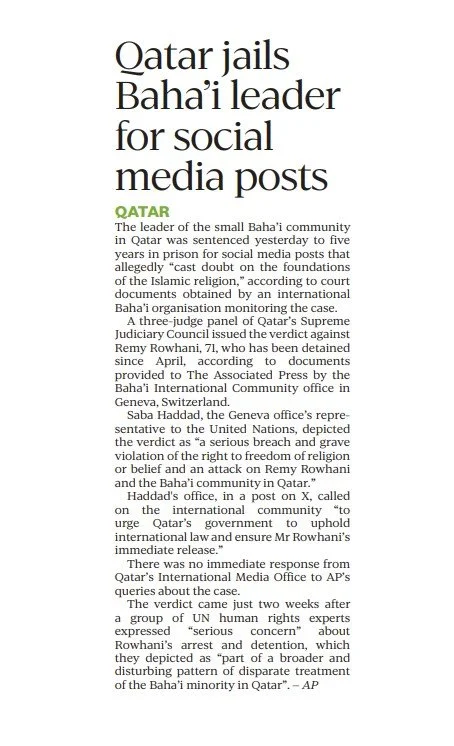
A recent article (below) dated 15 August was published in the Southland Times, a newspaper based in Invercargill, New Zealand, about Mr Rowhani and illustrates how all corners of the world are connected.
More articles and press releases on this topic
Bahá’í International Community (BIC) News article, 18 August 2025
Bahá’í International Community (BIC) News article, 15 August 2025
GENEVA—14 August 2025
Over 20 Baha’is in Isfahan are facing the confiscation of their homes, assets, and even vehicles, solely because of their faith. Authorities in Isfahan are invoking and grossly misusing Article 49 of the Iranian Constitution—a provision meant to recover property derived by illicit means—to seize the lawful property, freeze bank accounts, and block routine transactions of Baha’i citizens, without evidence, due process, or transparency. Many of the Baha’is were informed of these confiscations simply by an SMS, outside of any formal legal due process.
These measures are being driven through the Special Court for Article 49, a branch of the Revolutionary Court operating under the Executive Headquarters of Imam Khomeini’s Order (EIKO or “Setad” in Persian)—the body tasked with identifying and seizing assets deemed to be acquired through illicit means and returning them to their rightful owners, or to the public treasury if no owner is found. Under Iran’s own framework, property seized via Article 49 is placed at the disposal of the Supreme Leader, Ayatollah Ali Khamenei, through EIKO. In practice, this means confiscations targeting Baha’is are channeled to entities under the direct authority of the Supreme Leader.
“Article 49 was crafted to return stolen wealth—not to steal citizens’ possessions and completely deprive families of their homes and basic livelihoods,” said Simin Fahandej, Representative of the Baha’i International Community to the United Nations in Geneva. “What we are seeing is state-led theft, confiscation by text message. It is discriminatory, unlawful, and intended to impoverish a religious minority for no reason other than their faith.”
In recent months, authorities have opened new proceedings against nearly two dozen Baha’is—some already serving heavy sentences, others awaiting appeal, and some even with acquittals of previous cases granted on appeal—before the Special Court for Article 49. No evidence has been presented to justify the confiscations, which have swept up homes, farms, vehicles, and bank accounts.
Proceedings have been carried out in secret, bypassing due process. Cases are not registered in the judiciary’s central “Sana” (سامانه ثنا) system—the official e-justice portal through which legally binding summonses, hearing notices, and rulings must be served. Instead, Baha’is receive sudden SMS messages announcing that their files have been referred to the Article 49 court, while no record appears in Sana and defence lawyers are denied access to case files. Without presenting any evidence that assets were acquired illicitly—as Article 49 requires—entire families and co-owners, including individuals with no charges against them, have been the target of orders banning the sale or transfer of assets, confiscating homes, freezing bank accounts, issuing travel bans, and even seizing their vehicles during routine traffic stops.
“This is not law enforcement; it is economic strangulation under the guise of the law. Legal mechanisms meant to protect the population are now being used against them. This is a profound betrayal of justice.” said Ms. Fahandej. “The unlawful and arbitrary use of state power to seize Baha’i assets in Isfahan, is by definition, state-sanctioned theft.”
“How can the Iranian government see it as acceptable, either morally, legally, or even under its own religious teachings, to upend people’s lives with a single text message that their property and basic possessions, built over years, indeed decades of hard work, are suddenly confiscated and disappeared without a trace? Who is to be held accountable for the countless properties taken from the Baha’is since the Revolution, with no reason other than their faith?”
These actions are not isolated; they fit within a four decade-long pattern of state-sponsored confiscation of Baha’i property since the 1979 Islamic Revolution. Over these years, authorities have seized Baha’i community’s holy sites and cemeteries, and expropriated thousands of private homes, farms, and businesses. Courts have upheld expropriations of Baha’i lands in villages such as Ivel and in Kata, where authorities confiscated irrigated farmlands belonging to twenty-seven Baha’is in Kata in 2022, illustrating the continuous nature of dispossessions under Article 49.
Reports from court interactions describe a climate of intimidation. Judge Morteza Barati, who presides over the Special Court for Article 49 in Isfahan, has reportedly stated his intention to “strip” all Baha’is in Isfahan of their belongings and, in one incident, expelled a Baha’i woman from his office with the threat: “If the court is convened, we will ruin your life.” Individuals have been told that phone calls count as summonses and warned that arrest warrants will follow if they do not comply immediately—even when defendants are under electronic monitoring preventing their travel to court or are undergoing medical treatment. In one account, a woman receiving chemotherapy was told she must attend regardless, illustrating how cruel and heartless intimidation is being used to deter legal challenge and force compliance.
This new confiscation track has often been launched in parallel to existing cases. In one case, ten Baha’i women in Isfahan—Negin Khademi, Yeganeh Agahi, Yeganeh Rouhbakhsh, Neda Badakhsh, Mojgan Shahrezaie, Shana Shoghifar, Arezou Sobhanian, Parastou Hakim, Bahareh Lotfi, and Neda Emadi—were sentenced in October 2024 to a combined 90 years in prison; nearly a year later, each was notified—again by SMS and outside the official registry—that a new Article 49 case had been opened against her. More recent referrals have accelerated, occurring within weeks of interrogations or raids on homes.
Cases also reflect the breadth of these abuses. Hamid Monzavi, Arshia Rowhani, and Arash Nabavi—already under electronic monitoring—were informed they were barred from transactions while an Article 49 hearing was set; neither they nor their lawyers appeared as they were blocked from reviewing the files. Members of another family face fast-tracked confiscation of a pistachio farm despite prior acquittals, with lawyers still denied access. While yet another Baha’i in Isfahan received an SMS stating that his bank account had been frozen by court order, with no explanation provided.
“Across generations, Baha’i families in Iran have seen livelihoods erased, businesses sealed, and homes and properties confiscated”, said Ms. Fahandej. “Today, even years of honest work can vanish with a single text message.
“This is not just a matter of the misuse of legal process; it is the quiet dismantling of families’ lives, cutting them off from their savings, work, studies, and medical care. We urge the Iranian authorities to revive their conscience and recognise Baha’is as human beings in their own homeland, and restore what is rightfully theirs. We ask the Iranian government to simply respect its very own laws and its obligations under international law. Baha’is are not strangers in Iran, they are part of its fabric, its history, its future and until Iran embraces this reality, it can never hope to build a truly prosperous and inclusive nation, now or in the future.”
Follow news related to Baha’i human rights in Iran on X:@BahaiBIC_Rights and Instagram: @bahaibic_rights
Feature image: An image of Mr. Remy Rowhani as shared by the Bahá’í International Community’s (BIC) Facebook page.