Social Action Expressions Part 6
In this final instalment of the Social Action Seminar case study series, we explore initiatives emerging in Auckland, Queenstown, and Palmerston North that are striving to integrate spiritual principles into education, environmental stewardship, and community life. Together, and along with the other case studies featured in this series, they offer further insight into the learning shared during the Social Action Seminar held in Auckland in November 2025, and the growing capacity of communities across Aotearoa to contribute to social transformation.
Infusing Academic Curriculum with Spiritual Education
Ongoing sustained effort across multiple school contexts since 2021
The focus is on education, and releasing the potential of youth in formal learning environments
Between 2021 and 2025, a series of connected learning experiences unfolded across three school settings, exploring how spiritual and intellectual education could be woven together. This process was initiated by a Bahá’í high school teacher who sought to understand how young people might develop moral reasoning, purpose, and social awareness while strengthening academic engagement and a sense of meaning in life.
Early Learning in South Auckland (2021–2022)
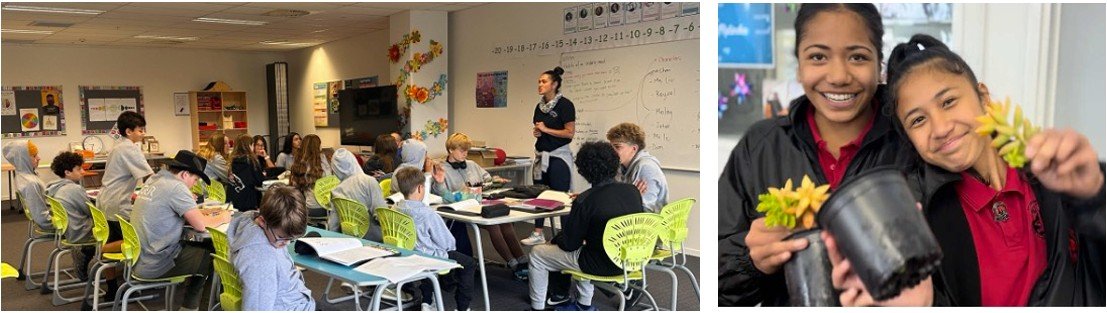
The first effort began in a mathematics class in South Auckland, where the teacher introduced the text ‘Thinking About Numbers’ to 45 students. The aim was to connect mathematical thinking with moral reflection—helping students see order, balance, and pattern as expressions of justice and cooperation.
The change in classroom culture was striking. Lessons became spaces of collaboration and joy, where students reflected not only on problem-solving but on how knowledge could serve their community. Yet, a key limitation soon emerged: the school was outside the teacher’s own neighbourhood, making it difficult to connect with families or sustain learning beyond the classroom. This insight led her to seek opportunities closer to home, where school, family, and community life could more naturally intersect.
Expanding Collaboration in East Auckland (2023–2024)
The next phase of learning took place at her local high school, where many youth from her neighbourhood— and from the junior youth group she had been animating—were enrolled. This allowed for a natural coherence between her classroom work and community service.
Within the school’s STEAM (science, technology, engineering, arts, and mathematics) programme, over 450 students in Years 7–8 studied the texts ‘On Health and Well-Being’ and ‘Observation and Insight’, using the Te Whare Tapa Whā (1) model to connect spiritual and physical wellbeing with scientific inquiry. Through projects in health, environment, and design, students began to see that intellectual growth and moral awareness are inseparable.
For Years 10–11, a group of 30 students participated in Service to Humanity seminars, deepening their understanding of collective service. Four animators and two community support people accompanied this process, guiding reflection, service projects, and peer mentoring. Projects addressed reforestation, health, waste management and climate action, culminating in community events and student exhibitions.
Through this period, the teacher and her collaborators observed that while schools often valued tangible outputs, lasting change arose from nurturing students’ inner capacities—confidence, empathy, and cooperation. Regular consultation among teachers and community members proved essential in maintaining coherence and learning from daily challenges.
This realisation laid the groundwork for the next stage of learning: testing how spiritual and intellectual education could be integrated more deeply within a school already committed to values-based learning.
Consolidation and Design in Queenstown (2025–Present)
Meanwhile, in Queenstown, an animator of a local junior youth group had been collaborating with the principal of a project-based high school. Observing the transformation of students involved in the group, the principal saw parallels with the school’s vision for education. When he learned of the Auckland teacher’s experience, he invited her to join the staff to help develop an integrated approach to moral and intellectual education from within the school itself.
From the outset, collaboration was key. The teacher and the local animator worked closely to align classroom learning with spiritual principles, meeting regularly to reflect and plan. Gradually, colleagues across the school began to appreciate the coherence of the Junior Youth materials— their structure, the concepts they explored, and the way intellectual and spiritual ideas were seamlessly interwoven. This process gradually broadened understanding among the staff and fostered a more coherent culture of learning within the school.
Queenstown presented a different reality from Auckland: while materially well-resourced, youth there often faced spiritual challenges such as isolation, overexposure to entertainment, and limited opportunities for meaningful service. The school’s values-based orientation provided fertile ground for exploring how spiritual education could address these needs.
Integrating Junior Youth Texts with Academic Projects
The integration began within mathematics sessions and expanded into interdisciplinary projects. The text ‘Habits of an Orderly Mind’ informed practical initiatives in biodiversity restoration and artistic explorations of identity and migration. The text’s emphasis on discipline and reflection, and systematic effort helped students manage their project workflows and connect their external actions with internal habits of thought.
Later, the text ‘Learning About Excellence’ guided a project in which students designed educational activities for a nearby preschool—applying concepts of service, cooperation, and responsibility through one-on-one visits. The experience allowed them to apply moral reasoning in a tangible setting, reinforcing the unity between learning and service. Outcomes such as art exhibitions—celebrating whakapapa, the oneness of humanity, and collective responsibility—ecological monitoring, and educational materials reflected outward achievement, but the more enduring result was the transformation in their outlook. Academic inquiry had become a vehicle for moral exploration.
At present (2025), one group of students studies the Junior Youth Spiritual Empowerment Programme texts weekly, while another is designing the school’s tikanga (values) and culture framework—seeking to integrate spiritual and intellectual knowledge into the identity of the school community. The collaboration between teacher, animator, and principal continues to deepen, as they explore how education can nurture both character and intellect. Gradually shifting the school’s orientation from “I am an explorer” toward the collective question: “What culture supports an identity shaped by who we are—together?”
Footnote: (1) Te Whare Tapa Whā is a Māori model of health that uses a meeting house (wharenui) with four walls to represent the four dimensions of wellbeing: taha tinana (physical), taha wairua (spiritual), taha whānau (family and social), and taha hinengaro (mental and emotional).
Growing Gardens and Communities
Ongoing sustained effort since 2020
The focus is on food sustainability, food sovereignty, and climate education—strengthening bonds among diverse faith and cultural groups while promoting service and unity
In Palmerston North, a grass-roots initiative emerged through collaboration among the Bahá’í community, the interfaith network, and local organisations such as Environment Network Manawatū, Manawatū Food Action Network, the City Council, and the City Library. The initiative focused on food sustainability, food sovereignty, and climate education—strengthening bonds among diverse faith and cultural groups while promoting service and unity.
In 2020, members of the Bahá’í community and representatives from other faiths began meeting regularly for walks, prayers, and consultation on serving their community. Inspired by a film on sustainability, the group decided to establish a teaching garden to promote food sustainability. When the pandemic began, participants used the time to plan and research.
About ten individuals from both communities formed Growing Gardens and Communities (GGAC), offering free gardening workshops through a local community garden. Over time, the group shifted from workshops to helping families set up home gardens, supported by small grants and volunteer networks.
By the end of 2021, twelve households had new gardens, many led by people facing hardship or health challenges. The group also began hosting “Let’s Grow Highbury” sessions at the local library, creating spaces for learning about gardening and sustainability.
Through 2022, volunteers maintained community plots and distributed food through local pataka kai and Just Zilch. The initiative grew rapidly—by late 2022, more than forty home gardens had been created, supported by partnerships with community agencies and a dedicated coordinator.
Between 2023 and 2025, GGAC and its partners helped nearly 200 families establish gardens, offering workshops on pruning, composting, and seed-saving, and supporting new iwi- and Pasifika-led initiatives. The programme expanded to three community libraries under the name Let’s Grow Palmy!
The effort strengthened relationships among diverse organisations—Kaianga Ora, Red Cross, Disability Support Services, and the City Council—and inspired new groups to form similar projects.
After six years, some founding volunteers stepped back due to changing circumstances, but the initiative’s impact continued through established partnerships and institutional support. The effort demonstrated how collaboration among faith-based and community organisations can release collective capacity and foster unity in service.
The Bahá’í community’s participation in the local interfaith planning committee contributed to interfaith collaboration on climate action, justice, and unity-building. In 2023, members took part in a national webinar series on climate action hosted by the Religious Diversity Centre, which inspired a series of community gatherings and consultations at the local library.
From these consultations arose the Climate Clarity Youth Forum, held in August 2025 with support from multiple regional and local institutions. Forty students from eight high schools participated in workshops exploring the effects of climate change on health and wellbeing, developing ideas for local action projects. Positive feedback led to plans for an annual youth climate forum, with the next one scheduled for Earth Day 2026, aiming to engage 100 students from across the region.
Key Learnings and Capacities Built
Participants developed capacities in consultation, collaboration, leadership, and systematic action. The initiative strengthened community bonds, enhanced organisational skills, and deepened understanding of sustainability and social responsibility.
Key principles applied included unity in diversity, equality, service to humanity, justice, and coherence between spiritual and material progress.
The greatest learning has been that cooperation among like-minded groups—motivated by love for humanity—naturally builds friendship, trust, and the collective will to serve.
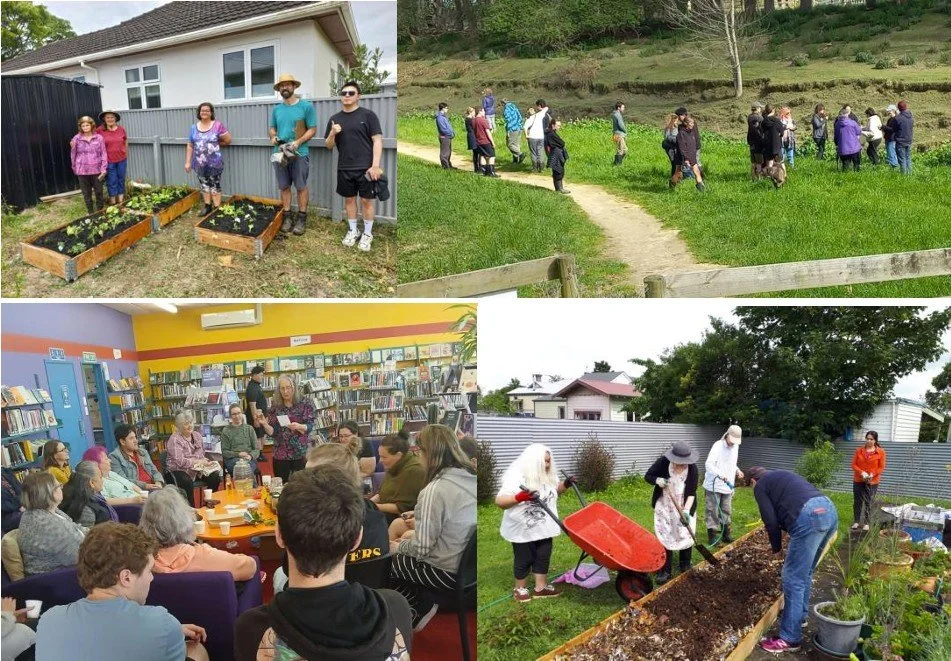
Images: Top left: Setting up home gardens with paid workers. Top right: Foraging workshop. Bottom left: Herb workshop. Bottom right: Setting up home garden beds.