Social Action Expressions Part 3
In the third instalment of this series, we explore two initiatives in Manurewa where friends are learning to apply spiritual principles to challenges related to wellbeing, education, culture, and community life. These initiatives, arising from grassroots efforts and sustained through consultation and collaboration, demonstrate how capacity for service can gradually develop, enabling communities themselves to contribute to their own spiritual and material progress.
Manurewa - A collaborative initiative with a local high school
This project is a sustained initiative which began in early 2025
The area of focus is education and raising capacity for service
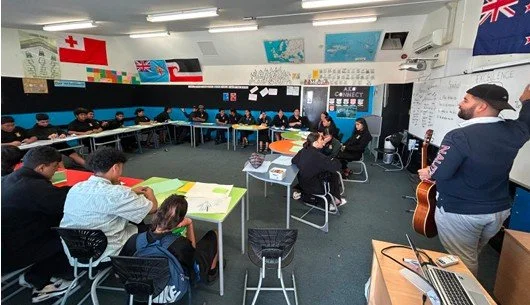
The Junior Youth Spiritual Empowerment Programme (JYSEP) was introduced to Manurewa High School in the Auckland cluster, as part of the school’s Wānanga curriculum for Year 9 and 10 students. The opportunity arose when a Bahá’í member of the Manurewa neighbourhood community-building nucleus, recently employed as a teacher at the school, sought to strengthen ties between the school community and the wider neighbourhood.
With support from his mentor teacher, he proposed the JYSEP as one of the choices offered through the school’s Wānanga programme, describing it as a Bahá’í-inspired initiative that assists young people to develop their moral insight and powers of expression in service to others. In an email outline, he was able to share the vision and socialise key concepts of the JYSEP with the deputy principal and coordinators of the wānanga programme, which resulted in a positive response. Named Empowerment Wānanga, the JYSEP became one of the choices of the school’s wānanga programme as it gained the support of the school leadership as a meaningful contribution to the holistic development of students.
The Empowerment Wānanga takes place weekly for a full day and ran consistently throughout the year [and is continuing into 2026]. Each school term, students study a different text from the JYSEP curriculum—Breezes of Confirmation, Wellspring of Joy, Habits of an Orderly Mind, and Glimmerings of Hope.
A team of friends from the local Bahá’í community, including an Auxiliary Board member and two experienced animators, support the teacher leading the effort. Around 35 students currently participate, while over 50 have completed at least one text since the programme began. The varying pace of students’ learning has provided valuable insights on how to adapt to the rhythm of school life.
Emerging Capacities and Principles in Action
Through this collaboration, a number of capacities have been cultivated among both teachers and youth:
The ability to collaborate effectively with a major educational institution.
The integration of spiritual principles—such as service, justice, and consultation—into a school-based learning space.
A growing culture of accompaniment, where youth support and learn alongside one another.
Regular consultation among the school’s teachers and the animator team has helped advance the programme and identify positive changes in students. Teachers have noted a strengthened culture of fellowship and excellence among participants, increased motivation and love to learn, and an ability to articulate ideas about purpose and moral choice (the power of their words!). Many students have begun describing the programme to their peers and inviting them to join.
An encouraging outcome of this initiative has been the way students have begun translating their insights into action. Some participants have assisted in neighbourhood children’s classes and attended local devotional and youth gatherings, deepening their understanding that true empowerment involves service to the community.
This growing connection between the high school and the neighbourhood has also drawn the interest of teachers, a few of whom attended the children’s class graduation. These evolving relationships point to the programme’s wider social impact—fostering a generation of young people who see education not only as academic advancement, but as preparation for a life of service and contribution to society.
Manurewa - Prosperity Foundation
This is a sustained endeavour, since 2019 a Bahá’í-inspired organisation.
The area of focus for this initiative is education
The Auckland cluster, with a population of 1.8 million, includes the Manurewa neighbourhood—a centre of intense activity serving around 20,000 people, mostly Pasifika and Māori. Over the past 13 years, Manurewa has sustained a pattern of intensive expansion and consolidation, with 71 core activities and nearly 500 participants engaged in the educational processes of the Bahá’í community. Firmness in the Covenant and devotion to the Universal House of Justice have allowed a healthy, evolving pattern of growth and learning to take root.
A generation of young people has now emerged through the institute process—graduates of the children’s classes, junior youth programme, and higher books of the main sequence of courses of the training institute —distinguished by a strong sense of commitment to their twofold moral purpose and a desire to serve society. Many have gone on to tertiary education, often the first in their families, reflecting the power of the training institute to inspire both spiritual and intellectual advancement.
Amid these developments, friends in Manurewa began to focus more systematically on education in all its forms, seeking to strengthen the integration of academic, moral, and spiritual education. To give coherence and structure to this process, the Prosperity Foundation, a Bahá’í-inspired organisation, was established in 2019, under the guidance of the senior institutions of the Faith.
The formation of Prosperity Foundation was also prompted by the need for an entity capable of formally engaging with schools. As the junior youth programme grew stronger at both an intermediate and a high school in Manurewa, it became clear that a Bahá’í-inspired organisation was required to coordinate activities, manage relationships with school leadership, and ensure the programme’s continuation in an educational setting. This early collaboration with schools—centred on offering the Junior Youth Spiritual Empowerment Programme as part of school life—became the first major expression of the Foundation’s work.
The Foundation’s early efforts established the Service to Humanity Programme, which accompanies youth aged 14–18 through their final years of high school. Through annual seminars and ongoing accompaniment, participants explore themes from the institute courses, youth conferences, and Bahá’í guidance while developing clarity about their education, vocation, and life of service. The programme has improved motivation, attendance, and purpose among youth, and is now being shared with other neighbourhoods in the cluster.
Building on this foundation, the collaborating friends in Manurewa have continued to advance their learning about the coherent development of youth. A growing concern is how to sustain those who began serving as animators in their teens and are now in their late teens or twenties—an age when many face intense pressures of materialism, individualism, and distraction. The Prosperity Foundation is therefore focusing on the pivotal question: What capabilities will enable youth to lead a life that is coherent in its spiritual, intellectual, and material dimensions?
To explore this, attention is being focused on small, well-defined groups of youth and junior youth working together. Older, experienced animators of the JYSEP accompany younger youth more closely, fostering friendship and shared service while helping both groups attend to their academic and spiritual development. Youth in their late teens are encouraged to engage directly with junior youth groups, offering academic support and personal mentoring informed by the institute materials. This setting becomes a space for learning about the qualities and capacities that allow a life of service to become a “fixed centre of one’s existence.”
Looking ahead, Prosperity Foundation will now take further steps to strengthen the link between spiritual and intellectual education. The organisation plans to begin integrating the study of Preparation for Social Action (PSA) units and complementary academic worksheets with the institute’s programmes. This next phase aims to help youth acquire practical and analytical capabilities—such as scientific thinking, social analysis, and coherent action—that will enable them to live lives of service and contribute more effectively to the material and spiritual progress of their communities.
We wish to stress that, historically and now, social action and efforts to participate in the prevalent discourses of society have emerged not only in the context of growth, but also as a result of individual Bahá’ís striving to contribute to society’s progress in ways available to them. As a personal response to Bahá’u’lláh’s summons to work for the betterment of the world, believers have variously chosen to adopt certain vocations and have sought out opportunities to support the activities of like-minded groups and organizations. Projects, both large and small, have been started in order to respond to a range of social issues. Numerous Bahá’í-inspired organizations have been established by groups of individuals to work for many different objectives, and specialist entities have been founded to give attention to a particular discourse. All of these efforts, at whatever scale they have been undertaken, have benefited from being able to draw on the principles and insights guiding the activities occurring at the grassroots of the worldwide Bahá’í community, and they have also benefited from the wise counsels of Local and National Spiritual Assemblies. We rejoice to see these diverse, harmonious expressions of faith by the devoted followers of the Blessed Beauty, in response to the tribulations of a perplexed and sorely agitated world.
Universal House of Justice, 30 December 2021 – To the Conference of the Continental Boards of Counsellors
Feature image: The Auckland Botanic Gardens, located in Manurewa