Social Action Expressions Part 4
The following case studies highlight how social action is emerging organically, as individuals and groups draw on spiritual principles to respond to the needs of their communities. In part four of this series of articles, we explore examples from suburbs in Wellington, including a community orchard and a devotional space. In each setting, a clear pattern of learning is unfolding.
Ola manuia, Massey University
Ola Manuia is a sustained initiative since 2022
The initial focus was on mental health and wellbeing in the context of a university campus, and evolved into building a vibrant community in a neighbourhood setting.
These efforts started, when a group of Bahá’í friends and their colleagues from the Pacific Public Health Research Team at Massey University attended the Wellington Global Conference in May 2022. Inspired by the session on “Building Vibrant Communities,” and invited to plan for action in small teams during the conference, they identified a need for a space where students and staff could come together and build this vision of contributing to a vibrant community in their place of work/study.
They initiated a weekly devotional space on campus and named it Ola Manuia (living well) – focused on community and spiritual wellbeing. One of the group spoke with the university’s wellbeing advisors, who offered a dedicated space for free use, as long as it was open to all. The advisors were happy to promote Ola Manuia and it quickly became a cherished place for reflection, prayer, and conversation. Participation grew, drawing in up to 35 people, joining to learn and share prayers and songs in different languages, and these expressions naturally extended to workplaces, community events, Holy Days, and even the funeral of a colleague. Participants spoke of how the gatherings offered a rare moment in their week to think about deeper, more meaningful aspects of life. Through the simple act of collective prayer and reflection, deeper relationships were formed across cultural, professional, and spiritual lines, embodying principles of inclusivity and unity in diversity.
Within a couple of cycles, Ola Manuia became a springboard for further community-building efforts. The friendships and trust built through the devotional space gave rise to a junior youth group being formed for some of the families of the participants, many of whom live in the Karori neighbourhood. Around the same time seven participants of the devotional gathering started to study Ruhi Book 1 Reflections on the Life of the Spirit together. A small nucleus formed coordinating several interconnected endeavours. Two youth joined the Institute for Studies in Global Prosperity (ISGP) and established a regular youth night in Karori West, attracting 10–15 participants. They later formally declared their Faith in Bahá’u’lláh and are now serving as assistants to an Auxiliary Board member. A rhythm of service began to take shape, strengthening participants’ capacity to consult, collaborate, and accompany one another in acts of service to their community (see below – Thurleigh Grove Community Orchard).
While the weekly campus devotions continue, Ola Manuia is now also offered fortnightly in a young family’s home in Karori West, providing a space where neighbours and university staff alike gather to pray and consult. Attendance has grown, with recent meetings bringing together around twenty participants. One associate professor expressed “I feel so honoured that you invited me,” sharing he was keen to be involved and even host it at his home in the future.
Today, the Karori West nucleus of six individuals meets frequently, with 20 individuals from 7 families gathering each cycle at whānau days to pray, reflect and plan. Over 70 individuals are connected to the community building process.
Thurleigh Grove Community Orchard
The involvement with looking after the Thurleigh Grove Community Orchard evolved out of the efforts of Ola Manuia and the Karori neighbourhood nucleus, and has been sustained since 2023
It focuses on the environment – stewardship, food security, and neighbourhood connection
The Thurleigh Grove Community Orchard is a sustained social action initiative focused on environmental stewardship, food security, and neighbourhood connection. Once a neglected green space, the orchard had fallen into disrepair when the junior youth group with its animator took the initiative in 2023 to revive it. What began as a practical effort to care for trees soon grew into a project rooted in service and collective learning. Guided by principles of unity, stewardship, and the oneness of humanity, the group sought not only to restore the land but also to strengthen bonds among families and neighbours. The orchard became a gathering place where people could work side by side, share food, and reflect on how tending the earth can mirror spiritual growth and community vitality.
As the orchard project evolved, participants developed both practical and spiritual capacities. They learned to care for trees, compost, mulch, and manage a shared garden ecosystem. Beyond technical skills, they cultivated patience, cooperation, and appreciation for the interdependence of all contributors—skills transferable to other aspects of life and service. The team also visited other community gardens, such as the Innermost Garden in Mt Victoria, where they learned about sustainable community engagement and mutual support. This reciprocal exchange deepened their understanding that meaningful social action requires humility, learning, and partnership. They also drew support from Wellington City Council’s Seeds-to-Feed initiative, receiving mulch and materials.
In addition to its environmental focus, the orchard has become a social hub for Karori West. Neighbours are invited to join in regular working bees and produce from the garden is freely shared among the community. A community hāngi/umu brought together families in celebration, reinforcing bonds of friendship and a spirit of joy and shared ownership. The orchard has also served as a bridge to other activities—introducing local youth to the Junior Youth Spiritual Empowerment Programme and inviting them into spaces of devotion and service. Through this project, participants have learned that environmental care can be a form of worship and social action that meets material and spiritual needs alike.
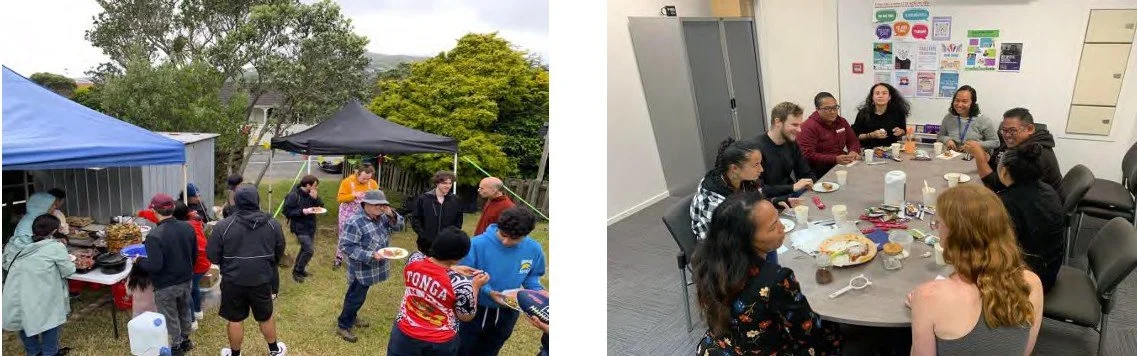
(Left) Celebrating with a hāngi/umu at the Thurleigh Grove Community Orchard. (Right) Students and faculty members at Massey University gathering in the wellness space for devotions, conversations and building bonds of friendship.