Insights from the Advanced Clusters Gathering, August 2026
On Saturday 8 August, representatives from advanced clusters across Australia and New Zealand gathered online to consult on the next stage of their collective learning during the second phase of the Nine Year Plan.
The Advanced Clusters Gathering focused particularly on two closely connected areas: expanding the pool of human resources and sustaining and multiplying centres of intense activity. Underlying both was a larger theme that was explored: how can communities increasingly become protagonists of their own development, with growing numbers of people taking ownership of the processes of learning, service and community building unfolding around them?
Experiences and learning were shared from advanced clusters across the region, including Brisbane, Melbourne, Perth and Tāmaki Makaurau Auckland. Counsellor Reena Torabi provided the context and framing for the gathering and centred the day's consultation around a continuing process of learning. The gathering primarily built on the recent zonal institutional meeting held in Sydney from 27–29 June with Dr Payman Mohajer, a member of the Universal House of Justice. Insights arising from conversations at the gathering in June helped provide a foundation for this August online gathering, which concluded with reflections from Counsellor Jeffrey Sabour, who spoke about the important role advanced clusters can play as reservoirs of knowledge, human resources and learning, contributing not only to their own progress but also, and importantly, to that of surrounding clusters.
Shared below is a brief breakdown of some of the key themes discussed and explored during this gathering.
The community as a protagonist
One important concept had prominence throughout the gathering: the community as a protagonist.
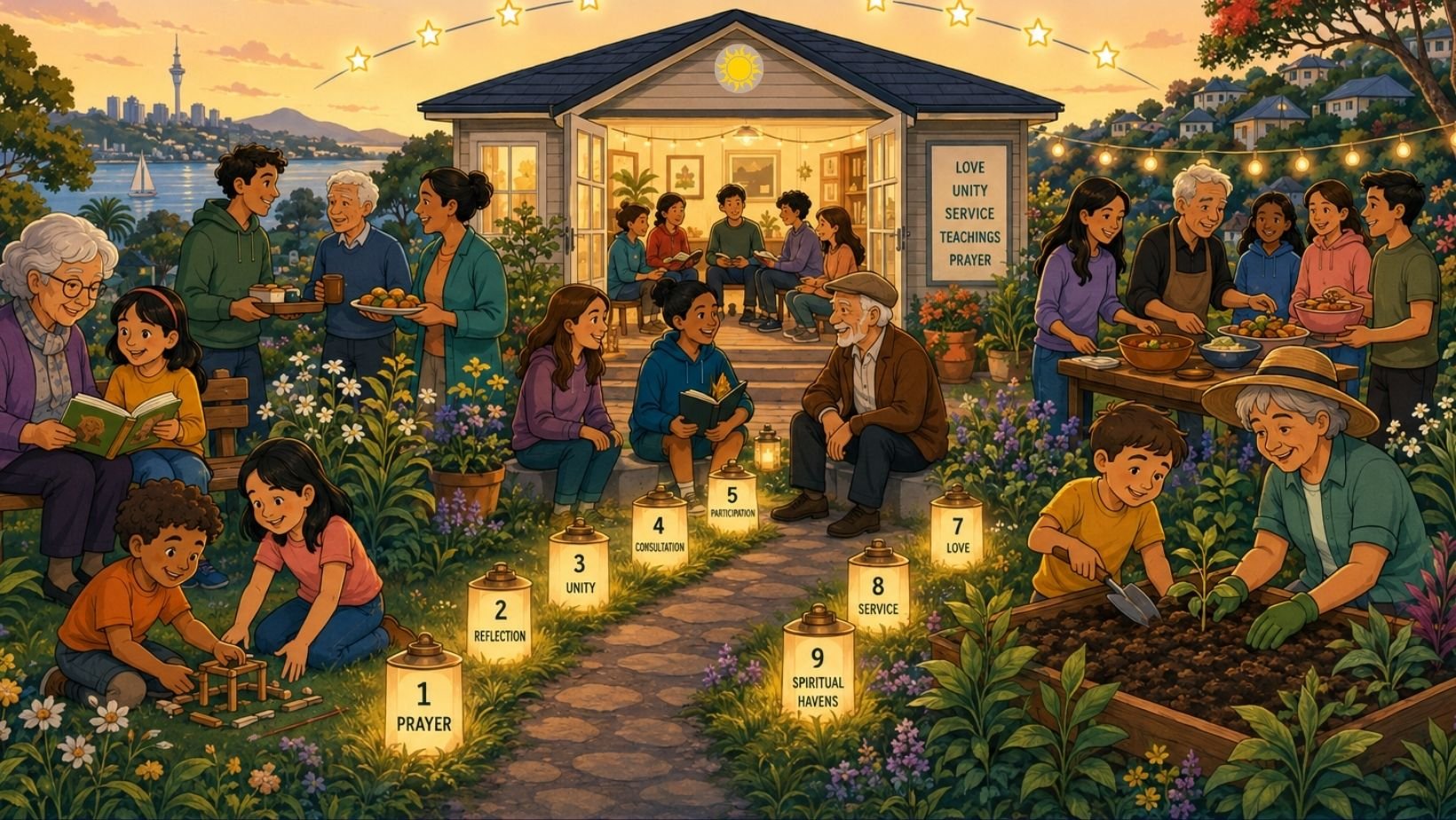
From an organisational perspective, community-building can sometimes appear as a collection of activities, plans, courses and structures. Yet viewed from the grassroots, it can look quite different. From that vantage point, it is viewed as families supporting one another, neighbours opening their homes to one another, young people gathering with their friends, children learning together, shared meals, conversations about matters affecting the community, and people gradually discovering their own capacity to be of service.
The gathering explored what it might mean for the institute process to become increasingly embedded within this everyday life of a community—not something that has been organised for a population, but something increasingly understood, supported and carried forward by the population itself. Formal structures continue to have an important role in providing coordination, encouragement and continuity, but at the same time, considerable attention was given to the informal relationships through which trust, initiative and learning naturally spread.
Learning from one another
A strong theme throughout the consultation was the importance of horizontal learning. For example, as community-building efforts grow, learning does not always need to travel from a neighbourhood to an institution and then back out to another neighbourhood. Communities can learn directly from one another. Neighbourhoods can connect with neighbourhoods, families with other families, and groups of friends with others engaged in similar efforts. Visits, conversations, friendships, consultation and shared action can allow useful experience to move naturally between settings.
Examples shared from different clusters during the gathering showed how more developed centres of activity can connect with emerging settings nearby, sharing experience and learning while allowing each community to respond to its own circumstances. The idea is to foster an ecosystem of learning in which communities develop the confidence and capacity to read their own reality and determine how best to move forward.
Building the capacity to grow human resources
Friends reflected on how people can be accompanied into service from the earliest stages of their involvement. Significant and sustainable growth can begin with relatively small groups of people. Groups of families, for example, can create settings where friendships deepen and conversations about the life of a community occur naturally. Prayer and devotional life, children's spiritual education, activities for junior youth, service and discussions about the needs of a neighbourhood can gradually become woven into the relationships between families.
Over time, more people discover that they, too, have a contribution to make and this connects closely with one of the gathering's principal areas of consultation: developing human resources. Study and service need not be seen as separate or sequential. Someone does not necessarily need years of experience before making a meaningful contribution.
Examples shared from across the regions included intensive institute camps connected directly with opportunities for service and accompaniment programmes that support young people as they develop their capacities. In various settings, friends are learning how greater confidence can be placed in individuals while they are closely accompanied, allowing capacity to develop through experience and action.
Young people as protagonists
Some encouraging examples of this learning were shared from Tāmaki Makaurau Auckland, where Institute coordinators have identified young people who naturally draw others together, including youth already serving as children's class teachers or participating in camps. These young people are increasingly being consulted about how the educational process might better engage their peers, those aged 15 to 18.
Rather than thinking only about what can be provided for young people, young people themselves are being invited to consider how they can help shape and advance the process. A great example of this is in Manurewa, where a junior youth camp held directly after an institute camp provided youth from the area with an immediate pathway from study into service. It also helped strengthen the engagement of youth already connected with the junior youth programme at a local high school.
Different communities, different possibilities
Other experiences from across Tāmaki Makaurau also demonstrated why reading the reality of a community is so important. In one setting, inviting whole families from the Chinese community, rather than approaching individuals separately, resulted in greater participation and sharing meals created a natural setting for friendship, elevated conversation and devotions to occur. In another, Māori friends gathered around the Hidden Words translated into te reo Māori. This process strengthened friendships and spiritual understanding and opened further possibilities for deepening conversations about the Faith. These experiences demonstrate there is no single formula that can simply be applied everywhere. Instead, friends are learning to pay close attention to the people and circumstances around them, to consult, act and reflect together, allowing approaches to develop in response to the capacities, needs and opportunities present within each population.
Releasing capacity at the grassroots
In his closing reflections, Counsellor Jeffrey Sabour drew attention to the role advanced clusters are being called upon to play during this phase of the Nine Year Plan, as strong reservoirs of experience, learning and human resources capable of contributing to the advancement of surrounding clusters.
Human resource development lies at the foundation of this effort. Discussions at the gathering highlighted that releasing this capacity requires more than increasing participation in programmes and it is hoped that as increasing numbers of families, youth, children and neighbours become involved, community-building can become less something carried forward by a relatively small number of experienced people and increasingly something woven into the life of a population, something that is natural and coherent with the lives of the members of that population.